Manual Therapy Forum
Inspiration, Education, and Empowerment
Theresa Larson DPT, CSCS, SFMA

… you can’t let anything stop you. Ever.
– Theresa’s mom (from Warrior: A Memoir)
The important thing for me is I’m having fun doing [physical therapy]. I can’t go into a career anymore where I’m just going through the motions, and having an insurance company tell me what to do. Nope. Sorry, that’s not gonna happen to me.
– Theresa Larson
In need of some inspiration? Get it right here. Theresa Larson is our guest for this interview. Theresa is currently a private practice owner in San Diego, CA. She is also co-creator of The Low Back Fix, a website program designed to help the average patient with lower back pain overcome their pain and regain their function. Theresa has written an auto-biography titled Warrior: A Memoir, where she chronicles events throughout her life that have led her to where she is today (side note – I read this book prior to our conversation and it is a worthwhile read!). In addition to all of these things, Theresa has been an instructor for MobilityWOD, a program developed by Kelly Starrett (author of Becoming a Supple Leopard). She has quite a few other accomplishments that would take a long time to describe, but I can list a couple more: United States Marine Corps second lieutenant and collegiate/professional softball pitcher. See what I mean… inspired yet? If not, just listen below…
Your brain has perceived this movement as a threat for a long time. You can rewire that. Let’s slow you down. Let’s teach you how to breathe. Let’s load the proper joints effectively, and over time… you will change… and you will be more functional.
– Theresa Larson
That’s what our job is, to empower people to continue moving. Versus disempowering them and telling them they can’t.
– Theresa Larson
Listen in here:
Or tune in down here:


Links of interest during this conversation:
Ola Grimsby
You are what you do, you are what you eat, and you are what you think
– Ola Grimsby
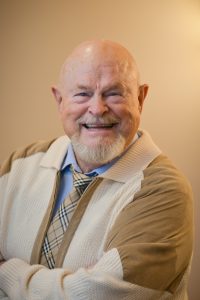
For our latest conversation, we get to speak with Ola Grimsby. Ola is a titan in manual therapy education, not only in the United States, but throughout the world. If you have heard of him, it is probably through his institute, the Ola Grimsby Institute. A big reason to want to speak with Ola was that he is a co-founder for the American Academy of Orthopaedic Manual Physical Therapists (AAOMPT). However, in getting to speak with him, I soon found out there were much better stories to hear and things to learn! For instance, we get to learn about the early days of manual therapy education here in the US, and how much of that depended on all the big names you’ve heard of (Mennell, Cyriax, Kaltenborn, etc.). Also, how Ola came to the US and traveled around the country teaching what he’d learned previously in Norway. Needless to say, if you are interested in history of manual therapy, or gain more understanding about what manual therapy is and what it can do, you’ll want to listen to what Ola has to say!
I would definitely like to see a consensus, first of all, in the amount of clinical supervision that a training is requiring. Instead of having research done on topics that is either partly clinically irrelevant or done by scientists who have not treated patients. That makes the outcome of the research rather questionable. I’m not opposed to research, that’s not what I’m saying, but it should be done by the specialists in clinical care. And the consensus should be based upon massive clinical experience and massive clinical repetitions of research projects.
– Ola Grimsby
There is nothing new under the sun. My contribution is absolutely minimal, and I think that goes for most of these old time gurus that are sitting on other people’s shoulders.
– Ola Grimsby
Listen in here:
Or tune in down here:
Links of interest mentioned during our conversation:
American Academy of Orthopaedic Manual Physical Therapists
International Federation of Orthopedic Manual Physical Therapists
Happy Thanksgiving

I’m thankful for my family, friends, colleagues, and all of you followers out there. Thank you for making this little project of mine worthwhile!
Matt
Manipulation of an Adducted Ulna

Dr. Thomason demonstrates how to manipulate an adducted ulna lesion. For this technique, it is most useful for a patient that lacks a lateral-to-medial glide of the proximal ulna against the humerus. Because of this specific loss of motion, the patient usually will present with limited pronation and a decreased carry angle of the elbow. As with any manipulation, safety is a priority. For this technique, pre-manipulative hold is important to make sure no undue stress is placed throughout the upper quadrant.
Cheers!
Matt
Tim Crunk, Kent Keyser, Seth Blee

Manual therapy has a long learning curve, so that’s frustrating for some, but I think it’s well worth it because it’s very rewarding to see people that have great need make great changes with your help. That can be a real wonderful thing.
– Kent Keyser
Work real hard to be humble and don’t let pride get in the way. It’s all about the patient, it’s not about you.
– Kent Keyser
Today, we have a special treat for all of our listeners. This isn’t any ordinary post (hopefully, you feel that about all of our posts) because we get to speak with three people all at once! Our conversation today is with Tim Crunk PT, DPT, MS, OCS, CFMT, FAAOMPT… Kent Keyser PT, MS, OCS, COMT, ATC, LAT, FFCFMT, FAAOMPT… and Seth Blee PT, DPT, CFMT. The main reason for having the luxury of speaking to three great gentlemen all at once was that we were all driving together from Denver airport to Steamboat Springs, CO for the CFMT examination week earlier this summer. If you gain a lot from a conversation we’ve had with one manual therapist… then you’ll definitely want to listen today with three times the experience!
I learn every day. There’s not a day I go to work where I’m not learning something from a patient that I’m seeing. As we look at each individual, we know that people function individually and in unique ways. So, one thing that keeps me constantly passionate and engaged is… I love learning and learn every day.
– Tim Crunk
I can’t think of too many professions [physical therapy], as I look around, where there is just so much to learn every day.
– Tim Crunk
It’s easy to be average, it’s easy to be mediocre. If you really want to be the best therapist, whether it’s owning your clinic, or working with some elite population, or developing courses, or whatever you want to do. That takes an awful lot of time, and energy, and passion. I hope people will be able to see that [we], hopefully have, and some of that can rub off on to some others that we’ll hopefully influence.
– Seth Blee
The best therapists are those that have the most humility, that can learn from their patients, and from… students that come in with them. Be willing to learn and be patient.
– Seth Blee
Listen in here:
Or tune in down here:
Links of interest mentioned during our conversation:
Comprehensive Physical Therapy
Innova Physical Therapy Center
CrunKeyser: Comprehensive Manual Therapy Seminars
North American Institute of Orthopaedic Manual Therapy
 Manual Therapy Forum